TUTORIAL 6. THE LORENTZ FORCE AND THE NATURE OF CHARGE
The standard Lorentz force law F = qv x B is merely a vector rule of association between a charge of a certain sign, a velocity, a magnetic field, and a deflection force that acts perpendicularly to both the velocity and the magnetic field. If offers no insight into the mechanism by which a charge moving through the field deflects. Maxwell introduced the vector relation B = curl A (where A is the vector potential) which allows B to share an axis of rotation with an angular momentum L. However, as soon as we allow this angular momentum to exist it creates a problem for the generation of an emf in a conductor. There must be a changing magnetic field line B both sides of the conducting wire and so the vector potential cancels out, see Figure 11(b). So, since electrons moving in alignment in a conductor are surrounded by a Sp-3 momentum field, our intention here is to replace the magnetic field line with a flow of electric field momentum p3f, see Figure12.

Figure 11 A changing magnetic field line B (running out of the page) with circulating vector potential A cutting an increment of conducting wire.

Figure 12 (a) Cross-section of conducting wire with electrons advancing out of the page showing Sp-3 momentum field rotation. (b) Magnetic field lines B to be replaced by electric field momentum flow p3f.
6.1 The Lorentz force deflection mechanism
Figure 13 shows Sp-3 field momentum lines p3f emanating from the north pole of a magnet. There is a field gradient where the momentum close to the pole is much stronger than that further away. A Sp-3 toroid approaches the field lines at speed v while rotating counter clockwise. Consequently, when the Sp-2 rotation is at a-b it is moving down and when it is at b-c it is moving up. Relative to the toroid, the field is moving towards the Sp-2 circuits with speed vrel. At a it is stronger than it is at b so the net effect is for the field to oppose the a-b rotation and reduce the action. Circuit a-b absorbs Sp-3 action to compensate and it slows in its Sp-3 rotation (moves up). At b the field momentum towards it is stronger than at c so the net effect is for circuit b-c to increase in action. The addition is redistributed into Sp-3 and circuit b-c speeds up (moves up). The net effect is for the Sp-3 to deflect upwards which is our expectation for an electron toroid.

Figure 13 A Sp-3 toroid approaching p3f momentum field lines at speed v while rotating counter clockwise. Relative to the toroid, the field is approaching at speed vrel. The Sp-2 rotation in position a-b is moving down while it is moving up in position b-c. The effect of the field interaction is for both to be deflected up.
6.2 The four geometric cases of charge

The rotation sense is defined in relation to the direction of motion so that in Figure 13, the Sp-2 is clockwise because of the Sp-3 rotation. Figure 14 shows the four chirality cases. Cases (a) and (b) result in an upwards deflection in the Figure 13 setup, so behave like negative charges. Cases (c) and (d) behave like positive charges with a downwards deflection. It should be noted that when the speed v in Figure 14(a) is reversed, as might occur from the point of view of a reference frames that passes it at greater speed in the same direction, we arrive at the arrangement in Figure 14(b). This means that all uniformly moving frames will 'see' a negative charge. In Figure 6 from Tutorial 4, the electron is represented by case (a) and the proton by case (c).
Figure 14 The four cases of charge chirality in which the direction of motion defines the rotation sense. Cases (a) and (b) are negative charges; cases (c) and (d) are positive.
CORRECTIONS
The Lorentz force Paper D available here represents an updated version to that on preprints.org which contains several errors.
The stealth positron
If the electron Sp-2 switches rotation to case (c) it becomes a positron (positive charge). This Sp-2 in Figure 6 would oppose the proton and would constitute the higher action case of the two electron Sp-2. This suggests that only the lower action Sp-2, case (a), gets ionized and the other becomes a stealth positron, being far less prevalent than the lower-action electron.
6.3 Charge passing through an electric field
Figure 15 shows an ionized electron with a counter clockwise rotation approaching two parallel electrified plates. This is case (a) in Figure 14. The conductor connecting the positive and negative plates has a counter clockwise field in the direction of the electron velocity v (clockwise in the current direction). The field between the two plates, for continuity of rotation, has a clockwise rotating field from negative to positive. When the counter-clockwise rotating electron approaches from the left, it encounters an oppositely rotating field at P from the positive plate which amounts to an attraction. The negative plate at Q presents a counter clockwise rotating field to the electron toroid, which is the same rotation and so is a repulsion.

Figure 15 Ionized electron approaching two parallel plates.
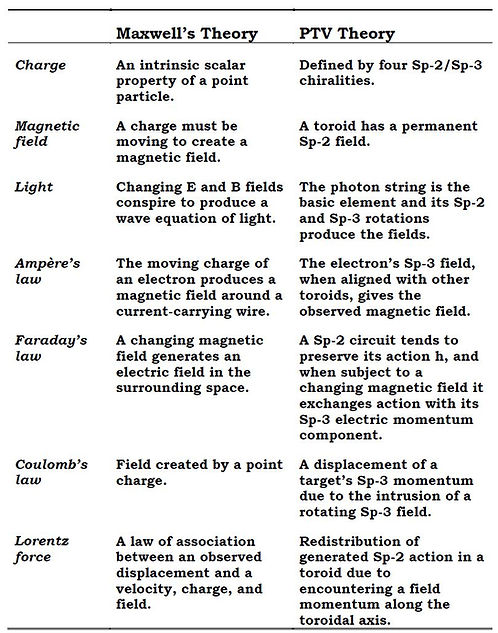
6.4 Comparison of Maxwell's theory with PTV theory
Paper A Paper B Paper C
Paper D
Paper E
Tutorial 5


Main page
NB: The displacement current is superfluous
The Bose-Einstein Distribution
Paper E shows how it is possible to derive the Planck radiation law on the basis of distinguishable photons. It shows that the notion of indistinguishability is not a necessity.

New hydrogen atom theory
Dr Barry R. Clarke, with grateful help from some friends, presents his new theory of the hydrogen atom at The Abandoned Trailer, Hampton Poyle, Oxfordshire, UK, to a captive audience. This short talk at the first Photonic Toroidal Vortex Theory Conference is based on his peer-reviewed paper published in Quantum Studies: Mathematics and Foundations in May 2025.